This is the first entry in my new Recipe Review Series. The Series is about each of my basic 20 recipes of my home brewery “Cockatrice Brewery.” Typically I will choose a recipe which I have recently brewed. Hopefully it will be interesting and informative. lol. Here we go!
Recipe #1: Malz de Quixote
Base Beer Style: Kölsch (BJCP) Style: 5B (Pale Bitter European Beer)
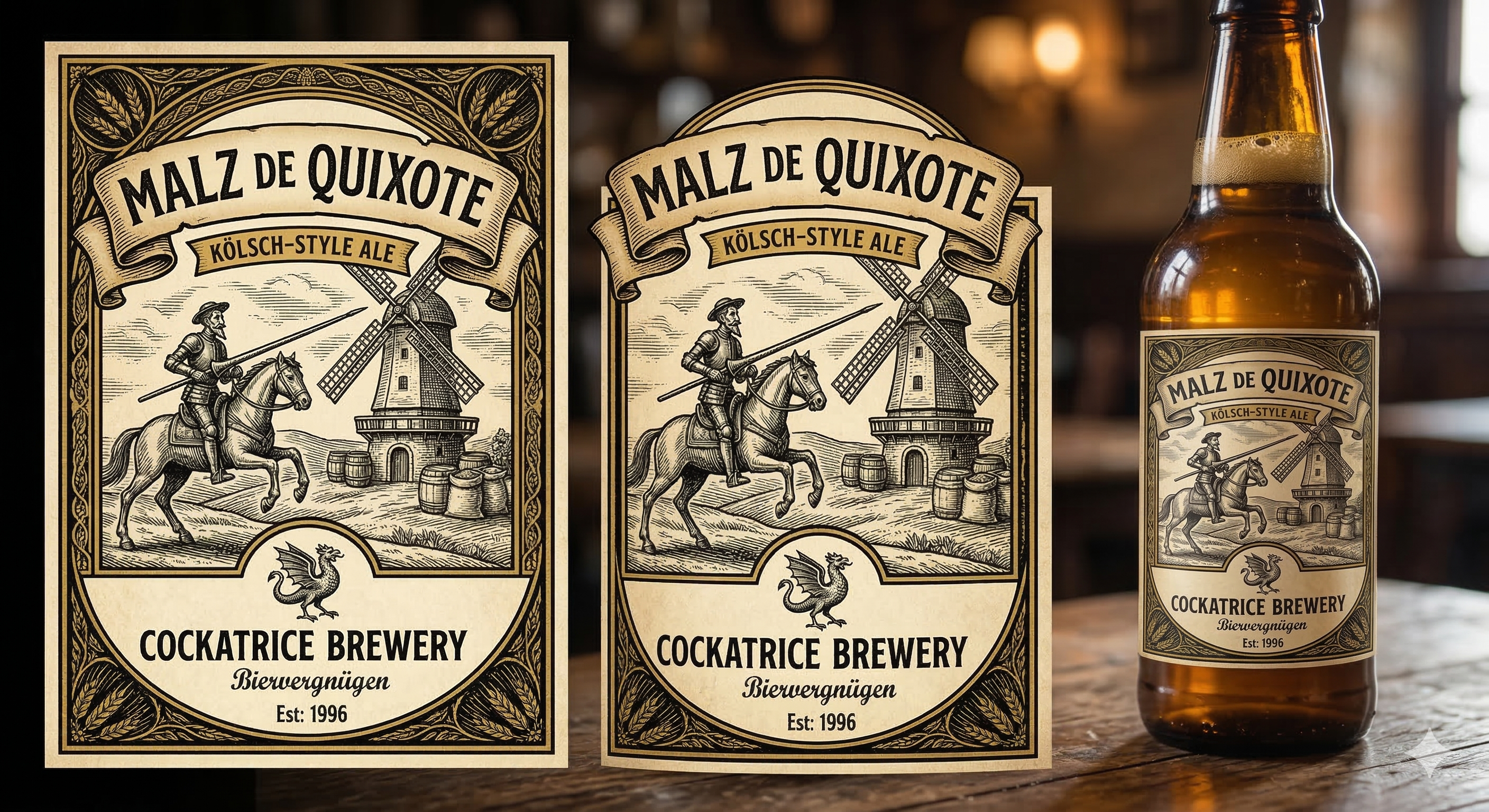
Description: This beer style originated in Köln, Germany. The name is protected so I call it a “Kölsch-style” ale. It is fermented at ale temperatures but then cold-conditioned (lagered). It is a very delicate beer and should be consumed fresh. I modeled my version on the beers produced by Brauerei zur Malzmühle. Their particular beer is slightly malt-forward compared to other kölsches in Cologne (Köln). The name Malzmühle means “Malt Mill” and their log has a windmill associated with it. So, as a BIG stretch, I named mine “Malz de Quixote” since Don Quixote did have an encounter with a windmill!
I use Brewfather for my recipe archive. Here’s a copy of this recipe.
Basic ingredients were: 1) Canada Malting Europils Malt and 2) Perle/Saaz Hops.
I brewed this beer on the 12th of January (2025). At the beginning of each year I’ve been trying to make a lager-style or specialty beer. Two years ago I brewed a German Pils and last year I made a Sahti. This year I decided on another German beer and I wanted something with a little lower ABV. Although the beer (traditionally) should be brewed by the Reinheitsgebot (Germany Beer Purity Law), I made a couple of modifications — I added a box of Firni Khas Ground Rice Pudding and some Belgian Candi Sugar. The Pudding because I had the box and wanted to get rid of it. I was suspicious that it might affect the flavor/aroma, but it doesn’t appear that it did. The Candi Sugar to add a little more fermentation without giving it more body. I did use the Imperial Dieter Yeast — almost a mistake because this batch was very slow in fermenting — so slow, in fact, that I added a packet of EC1118 to try and get it kick started! I don’t know if this is typical for the Dieter–I did make a starter. That seemed to go ok. Both of those yeasts combined have given a very clean fermentation profile, but it took 17 days in the Fermenter to get to my target gravity.
On the 29th of January I transferred to secondary and lowered the temperature over 3 days to 35F. I left it lagering until the 4th of March (33 days). I raised the temperature to 60F on the 5th, 68F on the 6th, and then bottled on the 7th. I added a second package of EC1118 for carbonation purposes.

Here it is in all its glory! As far as style goes (according to the BJCP), I get a low grainy malt aroma with a touch more hop (floral, herbal) than malt. The hop aroma might be closer to medium which would be a touch out of style but doesn’t detract. The golden color and delicate white head are spot on but there’s a touch of haze that’s out of style (might be from the rice pudding?). For flavor, there is a medium honey / light bread malt flavor followed by a medium floral hop flavor. The bitterness is medium. It has a medium-light body with a soft, dry finish. The aftertaste has a light lingering hop flavor/bitterness. I really like this version, but next time I’ll leave out the rice pudding and see if that helps it clarify (maybe I’ll add Irish Moss next time).
Enjoy!
Beer Mentor


 Beer Mentor