Yeast Wrangling

One of the things I’ve tried to do in recent years is to recapture and harvest yeast from the beers I’ve been brewing. Even one pack of dried yeast is $6 bucks! If you go with some of the specialty yeasts (liquid/what not) you are looking at $12 to $15 a package. With 9 brewing sessions this year, that would add up to about $100. I’ve worked really hard on capturing and storing the yeasts I use the most often. Here’s a picture of those in my beer fridge:

You’ll see I have one vial of “Brettanomyces Bruxellensis” from White Labs. The rest of the vials are all recaptures. I’ve got WLP 550, WLP 565, Hornindal Kveik, a few misc Orval (Brett Bs). I still have some dry yeasts packets as well.

Knock on wood, so far I’ve had great luck by re-pitching a starter (2 cups water, 1/2 cup DME) about 2 to 3 days ahead of brew day. I usually check my yeast health and do some random cell counting.

If it’s a big brew, I’ll do a bigger starter. I have a couple of 1 liter, a 2 liter, and a 5 liter flask if I need them! I had built a laminar flow hood, but I “gifted” it to a local brewery while I was living in Tucson (hopefully they are still using it). I would like to do some yeast culturing, so I’m probably going to have to build a new one — I’d like to build a smaller version — I’ll just have to figure out the noise reduction/venting issues in my “brewery.”

One of my goals over the next couple of years is to try and capture a local yeast (from one of the many fruit orchards near here) and see if I can make a passable beer from all British Columbia ingredients. The Gambrinus Malt house is about an hour north of me. I can get locally grown hops — I just need the yeast! I’ll keep my fingers crossed that I can capture some and it doesn’t smell like dirty socks. Stay tuned for more of this adventure!

Beer Mentor
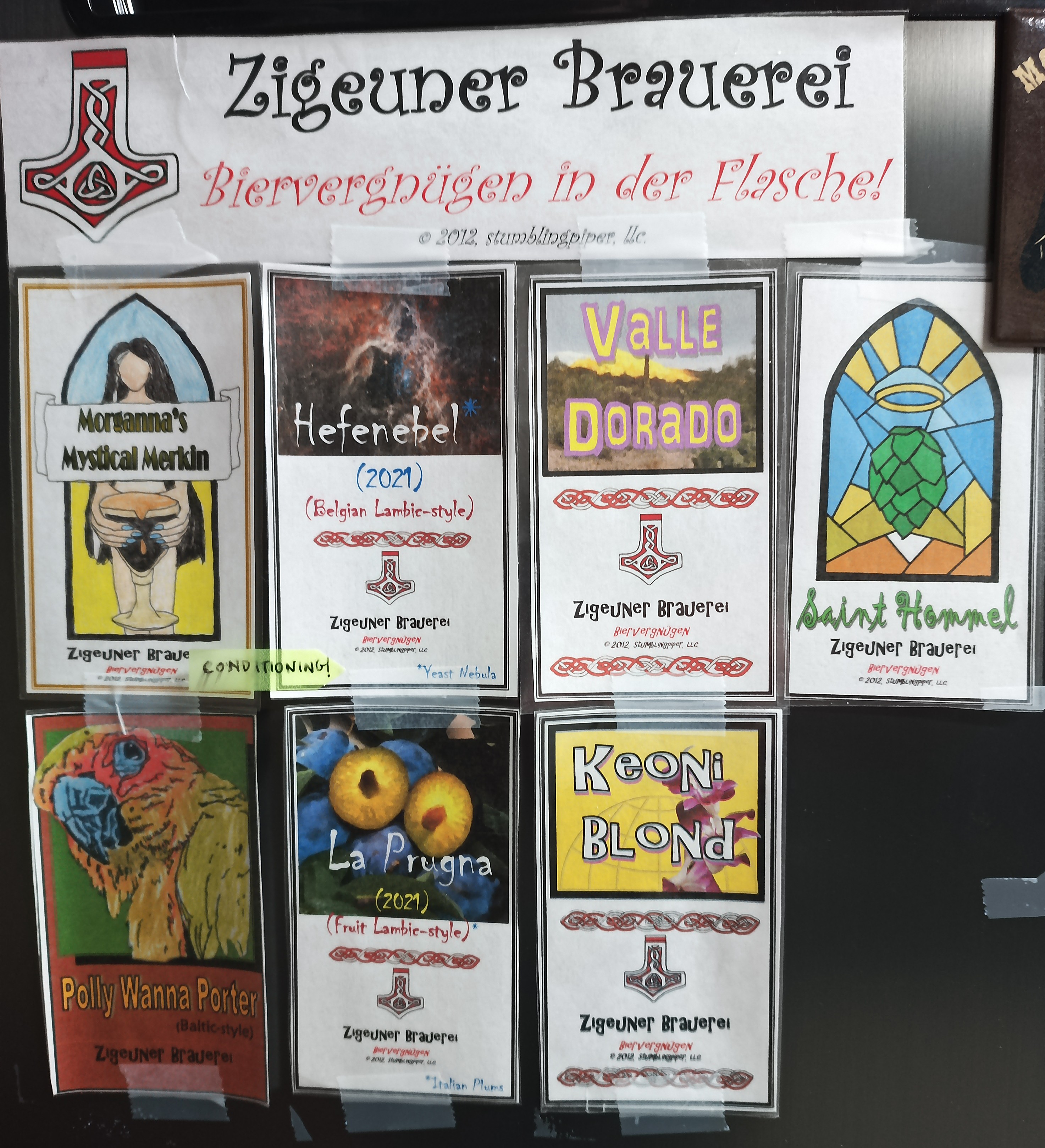
My Recipe Library: Ziggy Brau in the Beer Fridge!

The photo above is a current snapshot of the Ziggy Brau beers I have in my beer refrigerator. Several years ago, Volkswagen had a commercial talking about Fahrvergnügen. It basically meant “Driving Pleasure.” Here’s a link to one of the commercials. In a fit of creativity, I came up with this slogan for my beer fridge (and made it my Ziggy Brau slogan): “Biervergnügen in der Flasche.” It’s German for “Beer pleasure in the bottle.” To keep that “Biervergnügen” going, I’ve developed a brewing schedule to keep a plethora of different beers available in the fridge.

As I posted earlier, I standardized my brew setup and have now developed a pretty consistent brew routine/process. I’m pretty settled now on a Library of 20 Beers. There are three below that are not highlighted — I haven’t developed those recipes yet. The rest are in the library, and as you can see above, several are in the fridge!

This list covers all the styles I like to drink:

  1. Belgian Lambic-style Ale (Name: Hefenebel [Translation – Yeast Galaxy]). This is a continuing experiment — I just brewed the third version of it and will be making a Gueuze out of it at the end of this year! Oh, I also make a Fruited-Lambic (Name: La Prugna) with locally-grown plums. So (a) Lambic, (b) Gueuze, and (c) Fruit Lambic.
  2. Belgian-style Blond (Name: Keoni Blond). I brewed the first iteration of this beer on the day my grandson was born! April 11, 2021. Version 2 and 3 were right around his birthday as well. I love this beer — great flavor/color.
  3. Belgian-style IPA (Name: St Hommel). This is my attempt to clone the Hommelbier from Leroy Breweries in Belgium. I’m taking a trip there this year so I want to gather some notes on the flavor to use in adjusting my recipe. Would like to narrow it down and nail this one. I like the current version, but I’m just not convinced the hops are right yet.
  4. Orval Clone (Name: Valle Dorado) — my favorite beer — my clone is so close in flavor–I’m just off on color now–next iteration should dial it in!
  5. Monastic-style Dubbel (Name: Dubbel Trubbel). My Trappist-style Dubbel (Westmalle / Chimay clone). This one is very nice, but I haven’t made it in a couple of years. Looking at later this year (early winter, possibly)
  6. Monastic-style Tripel (Name: Die Drie Draken) My last Tripel was a little under-carbonated — I put it in the cold storage too soon. Flavor was nice. Gonna be a do-over–maybe 2025.
  7. Belgian/Monastic Dark Strong Ale (Name: Drakengeist) Also known as a Belgian Quad. This beer turned out very well (and has aged very well). I still have a few–need to work it back into the schedule … 
  8. Belgian-style Pale Ale (Name: Merlin’s Magical Elixir). I made two of these right in a row. The first one not so great, but the second one was nice. It is coming up again on the radar!
  9. Baltic Porter (Name: Polly Porter). I brewed this beer last year on my second grand-child’s birthday! Yum. I will be brewing it again this year. What I like about this one is that I can use the left over ingredients from my Barrel-aged Imperial Stout.
  10. Bourbon-oaked Imperial Stout (Name: Morganna’s Mystical Merkin) This beer has been great–I’ll do a whole post on this one later (Brewing again in March 2024). I char my own oak staves and soak them in Maker’s Mark Bourbon. This will be the fifth iteration — it just keeps getting better. I have a bottle from each of the last 3 years (I think). Time for a vertical tasting! 
  11. American Brown Ale (Name: Big Brown Beer) I made this one and it ended up having Brett in it. Still tasted good, but want a do over as well So far (fingers crossed), this is the only cross-contaminated beer I’ve had in my brewery. I should have called it “Big Brown Brett Beer.” haha.
  12. (Imperial) American-style IPA (Name: Wedding IPA). I made this beer in 2016 to celebrate our wedding and have made it four times since. Sometimes it is just big enough for a Imperial IPA and other times my mash efficiency keeps it in the IPA category.
  13. German-style Pilsner (Name: OK Premium Pils). This is a mid-winter beer for me to make — so it can lager into the early spring summer. This year I made the Eis-bock instead. OK stands for Okanagan (where I live), but also “OK” in the sense of OK. I found it funny using OK and Premium together.
  14. German-style Weizen Doppelbock/Eis-bock (Name: Frosty Billy). See previous post on this one. I really liked the flavor of this as a Weizen Doppelbock — but making the Eis-bock is fun, too. I might alternate them (every third year with the Pils)
  15. German-style Dunkel Weizen (Name: TBD). This is a beer in initial design phase. I have a smoked-pecan weizen recipe I really like … I might make it again as part of this recipe.
  16. Irish-style Red Ale (Name: Auburn Sunset). This is a collaboration I did with Kelowna Brewing Company — think Kilkenny or Smithwicks. It turned out nice — we are still working on this one to dial in the recipe.
  17. English-style Strong Bitter (Name: The Finger). Another collaboration with Kelowna Brewing Company. This one has turned out great — it’s been brewed a few times now. Ask me about the name over a beer. haha.
  18. Finnish-style Sahti (Name: Surreal Sahti). My experimental Finnish beer — turned out very nice–want to reduce the amount of liquid, bump up the rye and add a little more juniper next year. This will be a yearly brew (around December). Will make less than 3 gallons because it needs to be consumed fresh!
  19. Flanders-style Red Ale (Name: TBD). Work in progress.
  20. English-style Barley Wine (Name: TBD). Work in progress.

My schedule so far this year (2024) is quite full! Brewing approximately nine different beers.

  1. 2 Jan – Surreal Sahti
  2. 21 Jan – Frosty Billy
  3. 11 Mar – Morganna’s Mystical Merkin
  4. 11 Apr – Keoni Blond
  5. 12/13 Apr – Attend Penticton Fest of Ale
  6. 9 May – Polly Porter
  7. 23/24 May – Brew St Hommel with Sierra Nevada Brewing
  8. Jun (TBD) – Valle Dorado
  9. Oct (TBD) – St Hommel
  10. 6 Dec – Lambic #4 (Gueuze #1)

Frosty Billy: My Aventinus Eis-bock Clone …

My favorite German Beer is the Schneider-Weisse Aventinus (Weizen Doppelbock). It is a BIG beer and has an awesome flavor. You will see several posts here on my blog about this beer. I’ve enjoyed a tour of the brewery, attended the Aventinus Festival in Kelheim, and generally have determined that it is definitely an A++ beer.

A Weizen Bock is a strong wheat ale. Weizen in German means “Wheat.” The term Bock is more nebulous but really, in this sense, means “Strong Ale.” Another meaning for Bock is “He Goat.” That’s why on most traditional bock beers, you will find the image of a Goat (or Ram). Here are a couple of examples:

However, on Weizen Bocks, the label usually references some historical figure or religious saint … in Schneider’s instance, it is Aventinus, a (local to Kelheim, Germany) historical figure. Aventinus is actually called a Doppelbock — meaning an extremely strong (over 8% ABV) beer.

From Schneider’s Aventinus beer comes the Aventinus “Eis-bock.” An “Eis-bock” is made from “freeze distillation” — a fermenting “wort” (in this instance the Aventinus beer) is frozen and the ice is removed. In this instance, to get to 12% for Aventinus Eis-bock, they remove approximately 31.6% of the water content.

If you’ve had a Weizen beer, you recognize that the flavors/aromas are typically a sweet malt character supported with Banana esters and Clove phenols. These are yeast derived characters that support the sweet malt character and make Weizens some of the tastiest of beers (in my opinion). Making it even stronger requires great balance and skill — something Schneider demonstrates time and again. Both of these beers are the best examples (see here) and that’s why I wanted to try and clone them.

To get the big beer I wanted in my current brew setup, I had to use some dry malt extract with my other grains. I used what I called a “fake decoction” process (a step mash really) and an open fermentation to try and match the ester/phenol character in the Weizen doppelbock. I think I hit it pretty well–ending up with an 8.7% beer. Then, I tried the freeze distillation — my target was to remove about 27.5% of the ice to get to that 12% ABV level. I was not patient enough and only removed about 8% of the ice … ending up with a 9.5% ABV “Eis-bock.”

Because I didn’t have any patron saint or historical figure in mind to name my beer after, I took the traditional meaning of Bock and a winter theme and came up with “Frosty Billy.” Here are the two beers compared side-by-side.

The one on the left is my Eis-Bock — the one on the right is the Aventinus. The middle, single glass is the Aventinus … so clear! Mine is the one on the right. Both have really good flavor. I can tell the Aventinus is aged — it has a great oxidized character of plums/raisins/molasses. So good! The flavor/alcohol are balanced nicely. The flavors are there in mine — since it’s only been in the bottle for a week or so it needs time. In another couple of months, it should really be entering its prime!

I really enjoyed making this beer … I’m hoping it will be my annual February Beer. We’ll see.

Beer Mentor